
Despite geopolitical tensions and FII outflows, Indian small and midcap stocks have not only recovered losses but are also outperforming largecap indices, driven by attractive valuations, domestic institutional support, and a rebound in earnings.

All the countries in the top 10 have seen a decline in market value.

Indian benchmark indices Sensex and Nifty closed lower in a volatile session due to profit-taking in banking and financial shares, despite earlier gains driven by easing geopolitical tensions. Analysts suggest investors remain cautious and are not aggressively chasing the recent rally.

The Dalal Street was on Tuesday abuzz with an eerie coincidence that took place last night in the Wall Street, the US stock market, with its benchmark index S&P 500 closing at a level exactly same as that of October 3, 2008.

Inflation data, trading activity of foreign investors and global trends would dictate sentiment in the stock market this week, according to analysts.

The Indian government's decision to ban sugar exports until September 30 has drawn sharp criticism from the sugar industry and farmer leaders, who fear long-term negative impacts despite the stated aim of controlling domestic prices and ensuring availability.

The Indian rupee saw a significant appreciation against the US dollar following President Trump's suspension of military strikes against Iran and the Reserve Bank of India's decision to maintain its key interest rate. Market sentiment was further buoyed by positive comments from the RBI regarding the health of the banking sector.

The Haryana government is taking strict measures to combat the black marketing of cooking gas cylinders, registering FIRs and seizing hundreds of cylinders. Officials assure citizens of sufficient LPG supply despite global concerns.

The Indian government has reassured citizens that the country has sufficient reserves of petrol, diesel, and LPG, and that refineries are operating at high capacity despite global supply chain disruptions. They have urged citizens to avoid panic buying and hoarding.

With investments by foreign investors expected to rise in the coming months, the total overseas fund flow this year could well surpass the highest ever figure recorded in 2007, when India attracted a whopping Rs 70,000 crore (Rs 700 billion).

Despite a sharp increase in import duties on gold and silver to 15 per cent, the precious metals are trading at significant discounts in the domestic market, with gold seeing discounts of up to $200 an ounce and silver up to $6 an ounce.

Global index provider MSCI has announced the addition of four Indian companies-including Fortis Healthcare and Paytm - to its Global Standard indices. According to Nuvama Alternative & Quantitative Research, each of these companies is expected to see passive inflows exceeding $400 million. Shares of Paytm rose 4.3 per cent on Thursday, while Fortis Healthcare dipped 1.1 per cent.

Domestic Institutional Investors (DIIs) have significantly increased their holdings in Nifty 500 companies, reaching a record 20.9 per cent by the end of March, while Foreign Portfolio Investors (FPIs) reduced their ownership to an all-time low of 17.1 per cent, according to Motilal Oswal Financial Services.

The Indian rupee depreciated significantly against the US dollar, reaching a new all-time low due to rising oil prices, a strong dollar, and ongoing geopolitical concerns. Domestic equity market declines and foreign investment outflows further contributed to the rupee's weakness.
Investors have not received their hard-earned money back in several high-profile cases.

India's aviation sector is facing fresh turbulence, with rising fuel costs, the Ministry of Civil Aviation's free-seat directive, and geopolitical disruptions in West Asia clouding near-term earnings visibility.
In rupee terms, market capitalisation inches closer to GDP.

Sun Pharmaceutical Industries' acquisition of US-based Organon & Co. for $11.75 billion, the largest overseas acquisition by an Indian pharma company, has been met with mixed reactions from brokerages, who see strategic entry into women's health and biosimilars but also flag potential integration challenges and debt concerns.

'Given that India underperformed emerging markets by 28 per cent in 2025, the worst performance in over 30 years, the timing of the sharp STT hike could have been better.'

'The day that the market realises that they've overspent (on AI) and there's a sudden collapse in the capex, then India can start outperforming again.'

Quarterly earnings, macroeconomic data announcements and global trends will drive the Indian stock markets in a holiday-shortened week, analysts said. Stock markets would remain closed on Wednesday for the Guru Nanak Gurpurab holiday.

Indian benchmark equity indices, Sensex and Nifty, snapped a three-day rally, tumbling nearly 1 per cent due to heavy selling in IT stocks, a jump in crude oil prices, foreign fund outflows, and fears of prolonged instability in West Asia.

'OMCs are incurring losses of Rs 1,000 crore per day due to the West Asia crisis.'

A fall in the Nifty 50 to around 19,000 is not impossible, but that would likely require nuclear options to be exercised.
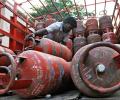
Delhi Police have registered multiple FIRs and seized hundreds of LPG cylinders in a crackdown on illegal storage, refilling, and black marketing operations amid concerns of potential supply shortages.

Bharat Forge reported modest Q4FY26 results but provided strong guidance, anticipating significant growth from its defence, aerospace, and data centre segments, with a projected 25 per cent revenue growth in Indian manufacturing for FY27, despite current high valuations.

Dabur India's stock has fallen over 17 per cent since the start of the Iran war, driven by concerns over a weak monsoon, the West Asian crisis, and rising input costs, which are expected to impact the company's revenues and margins, particularly affecting its significant rural sales and international markets.

'First-time applicants may witness longer approval times or higher rejection rates and requests for more documentation.'

Maruti Suzuki has discontinued its Ignis hatchback due to weak sales and a shift towards SUVs, while simultaneously facing supply chain issues for its popular S-Presso and WagonR models, leading to booking halts at some dealerships.

'I cannot imagine that any NSA before Ajit Doval would have given us this kind of time and this kind of engagement. They would have offered slogans, or nothing at all. That, too, tells you something.'

He alleged that besides Modi and Shah, Finance Minister Nirmala Sitharaman had also commented on the stock markets ahead of elections, which has never happened in the past.

With duties at 15%, GST at 3%, and making charges running as high as 20% -- the gap between a smart purchase and a careless one can easily be Rs 30,000 to Rs 50,000 on every Rs 1 lakh invested. And most of that gap is entirely avoidable. Ramalingam Kalirajan explains the math.

India is well-stocked with inventories of crude oil and key petroleum products, including petrol, diesel, and aviation turbine fuel (ATF), to deal with short-term disruptions as the war intensifies in West Asia, Union Minister of Petroleum and Natural Gas Hardeep Singh Puri said on Tuesday.

Indore police have busted a gang involved in investment fraud, arresting five individuals and uncovering links to a WhatsApp account operated from Cambodia.

The diagnostics sector is projected to significantly outperform other healthcare segments like pharmaceuticals and hospitals in Q4FY26, driven by increasing volumes, stable realisations, and a domestic focus that insulates it from geopolitical risks.

'When markets go into a budget with excessive optimism, the risk of disappointment is higher.'

'Mark Mobius's life was dedicated to investing.'

The biggest bounce is in the realty sector, where the industry index jumped 80%. There's been a turnaround also in automobiles and ancillaries (up 45%). The pharma and health care indices have a welcome return of roughly 35%.
In total, the stock market wealth has come down by a whopping over Rs 11 lakh crore (Rs 11 trillion) since the beginning of 2011, as the benchmark Sensex plummeted by over 3,000 points.

The European Union's (EU's) offer to slash tariffs on 97.5 per cent of Indian chemical exports to zero is set to give India's pharmaceutical and medical device firms preferential access to the European markets.
 © 2026 Rediff.com - Advertise with us - Disclaimer - Privacy Policy - Sitemap - Feedback - About us - Terms of use - Grievances